
CPN, Nutritionist or Dietitian:
What Do the Different Titles Actually Mean?
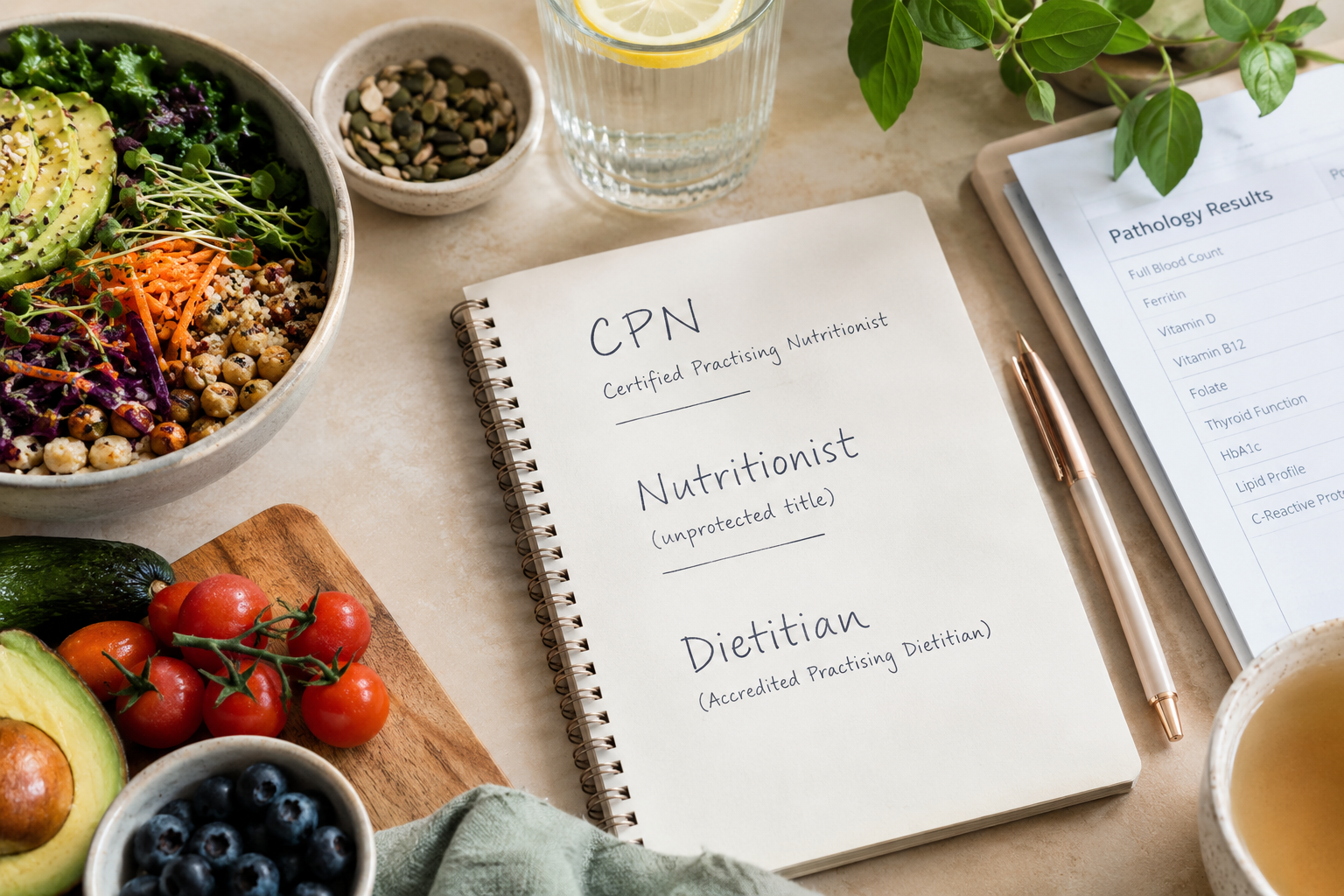
If you've ever tried to work out whether you need a nutritionist or a dietitian, then stumbled across something called a Certified Practising Nutritionist and felt none the wiser, you're in good company.
The titles can sound almost interchangeable, but the training and scope behind them can be quite different.
The easiest place to start is this: a Certified Practising Nutritionist and a dietitian are both qualified clinical nutrition professionals, with their own education, clinical training and scope of practice. Nutritionist, on its own, is different because the title isn't protected in Australia and tells you very little about the training behind it.
That doesn't make one profession better than the other. They are different professional pathways, with some overlap and some important differences in how they approach clinical care.
Understanding those differences makes it much easier to work out who might be the right person for you.
What is a Certified Practising Nutritionist?
A Certified Practising Nutritionist, or CPN, is a tertiary educated, degree qualified and clinically trained nutrition practitioner whose qualifications and competencies have been assessed against defined professional standards.
CPNs are trained in areas including pathophysiology, pharmacology, clinical examination, complex case taking, counselling, clinical nutrition and nutritional medicine prescribing.
They are primary care nutrition practitioners who can work independently while also working alongside GPs and other allied health professionals where appropriate.
The training is designed to look at both health and disease, with a strong focus on understanding the individual rather than simply treating a diagnosis.
That means considering your symptoms, health history, lifestyle, pathology, nutritional status, medications and supplements, and where appropriate, further testing.
AARPN is the professional body responsible for the CPN credentialing program and sets the education, competency and professional standards for CPNs. You can learn more about CPN training and professional standards through Allied Health Professions Australia and the Australasian Association and Register of Practicing Nutritionists (AARPN).
There is also an important distinction when it comes to therapeutic supplements.
Under Section 42AA of the Therapeutic Goods Act, clinically trained nutritionists are recognised in legislation in a way that supports their independent prescribing capacity for therapeutic nutritional supplements within their professional scope. AARPN notes that clinically trained nutritionists have been formally recognised as health professionals under this legislation since 1989.
So a CPN is not simply providing general healthy eating advice.
Clinical nutrition is a distinct professional field that brings together nutrition science and medicine, with training that allows practitioners to work with more complex nutritional and health presentations.
What is a Nutritionist?
This is where things become confusing.
In Australia, nutritionist is not a protected title.
Someone can use the word regardless of the level or type of training they've completed.
Behind the same title, you might find someone with a university degree and extensive clinical training, or someone who has completed a much shorter course.
From the outside, those two people can look exactly the same.
That's why it's important to look beyond the word nutritionist and find out what qualifications and professional credentials someone actually holds.
Ask what they studied, how much clinical training they completed, what professional body they belong to and whether they are required to maintain ongoing professional development.
The title alone doesn't tell you enough.
It's also worth understanding that a CPN is not simply another name for a nutritionist. The CPN credential identifies a practitioner who has met defined education, clinical training and competency requirements through the professional credentialing process.
What is a Dietitian?
Dietitians are university trained nutrition professionals who complete an accredited course of study in dietetics, including clinical training.
Accredited Practising Dietitians, or APDs, hold a recognised professional credential through Dietitians Australia and work across hospitals, private practice, aged care, community health, research and primary care.
A significant part of dietetic practice is medical nutrition therapy. This involves using nutrition as part of the management of diagnosed health conditions.
For example, a dietitian may work with someone with type 1 diabetes, kidney disease, coeliac disease or a gastrointestinal condition, providing specialised nutritional care as part of their medical management.
Dietitians can also work across multiple areas of a person's health. The distinction isn't that dietitians only look at one disease or that CPNs are the only professionals who consider the whole person.
The difference is more about the training, clinical framework and scope each profession brings to that work.
So what is the difference between a CPN and a dietitian?
This is probably the question people are really trying to answer.
The answer isn't that one is more qualified than the other.
Dietitians and Certified Practising Nutritionists are different clinical nutrition professions, with different training and areas of focus.
There is considerable overlap between the two, and there are situations where seeing both can be valuable.
One of the key differences is the clinical framework through which the practitioner approaches your health.
Dietitians are trained to provide specialised nutrition and dietetic care, including medical nutrition therapy for diagnosed disease states.
A CPN is trained to consider that diagnosis within the context of the whole person.
Because people rarely have just one thing going on.
An example
Take someone living with type 1 diabetes.
Their diabetes is obviously important, and a dietitian can provide specialised nutritional support for managing the condition.
But what else is happening with that person?
Perhaps they are also experiencing digestive problems, fatigue, nutrient deficiencies, poor sleep or another autoimmune condition.
Perhaps their pathology raises other questions. Perhaps their diet, medications, lifestyle or nutritional status are also influencing how they are feeling.
A CPN is trained to step back and consider those different pieces together.
Rather than asking only:
"What nutritional advice is appropriate for this condition?"
the clinical nutrition approach can also ask:
"What else is happening in this person's health that may be influencing how they're feeling and how this condition is presenting?"
The aim isn't to ignore the diagnosis.
It's to understand the diagnosis within the context of the person who has it.
That broader perspective can be particularly useful for people with multiple health concerns, persistent symptoms or situations where the different pieces of their health don't seem to fit neatly into one diagnosis.
It doesn't mean that dietitians don't consider the person as a whole.
It means that whole person assessment is central to the clinical nutrition and nutritional medicine approach.
What if you don't have a diagnosis?
You don't need to.
Many people come to a clinical nutritionist because they have ongoing symptoms that haven't been explained, or because they know something doesn't feel right even though they've been told their results are "normal".
They might be experiencing bloating, reflux, constipation, diarrhoea, fatigue, brain fog, poor sleep, hormonal concerns or unexplained changes in their weight.
In these situations, there may not be one diagnosis to work backwards from.
Instead, the starting point is the person.
Their symptoms.
Their history.
Their lifestyle.
Their pathology.
And the relationships between those things.
A clinical nutrition consultation allows us to step back and consider whether there are factors contributing to how you're feeling that haven't yet been considered.
That doesn't mean assuming every symptom has a nutritional explanation or replacing appropriate medical care.
Sometimes the right next step is further medical investigation or referral to another practitioner.
Knowing when to refer is an important part of good clinical practice.
Can you see both a CPN and a dietitian?
Absolutely.
In fact, there are many situations where different professionals can bring valuable perspectives to the same person's care.
A dietitian may provide specialised nutritional management for a particular disease state, while a CPN may bring a broader clinical nutrition perspective to the person's overall health.
Your GP or specialist may be managing your diagnosis and medical treatment, while other allied health professionals support different aspects of your health.
These roles don't need to compete.
At Learn To Nourish, we see ourselves as working alongside your GP, specialist, dietitian and other allied health professionals rather than around them.
If something falls outside our scope, we'll tell you and help you find the right person.
What should you look for when choosing a nutritionist?
The title is only the starting point.
Before booking, look at:
Education: What degree or qualification have they completed?
Clinical training: Have they undertaken formal clinical education and supervised practical training?
Professional credentials: Are they part of a professional body with defined standards and ongoing professional development?
Scope of practice: Are they clear about what they can help with and when they would refer you elsewhere?
Approach: Do they take the time to understand your health history, symptoms and circumstances, or are you simply being given a generic meal plan?
Qualifications matter, but so does the way someone approaches your health.
Where does Learn To Nourish fit?
Learn To Nourish is led by Benedict Freudenmann, a Bachelor qualified Certified Practising Clinical Nutritionist and allied health professional.
Benedict has a Bachelor of Health Science in Nutritional Medicine and more than 12 years of experience working in clinical nutrition.
His approach is centred on understanding the full picture of a person's health.
That means looking at your symptoms, health history, lifestyle and pathology together, and considering how different aspects of your health may be connected.
Where appropriate, this may include targeted testing, dietary changes, nutritional supplementation and lifestyle strategies.
It also means working alongside your existing healthcare team and knowing when further medical investigation or referral is needed.
The goal isn't to give you another list of things to manage forever.
It's to help you understand what may be contributing to how you're feeling, make meaningful changes and take greater control of your health over time.
The bottom line
A Certified Practising Nutritionist and a dietitian are both qualified clinical nutrition professionals, but they follow different professional pathways and bring different training and approaches to their work.
A nutritionist, on its own, is a broad title in Australia and doesn't tell you what level of training someone has completed.
The right choice isn't about finding the "best" profession.
It's about finding the right clinical approach for you.
Sometimes that's a CPN.
Sometimes it's a dietitian.
Sometimes it's both.
And sometimes the first step is simply finding someone who will take the time to listen to the whole story and help you work out what needs to happen next.
Not sure where to start?
The easiest place to begin with Learn To Nourish is a free 15 minute call. It's a relaxed opportunity to ask questions, explain what's been going on and see whether we're the right fit for you before booking a consultation.